
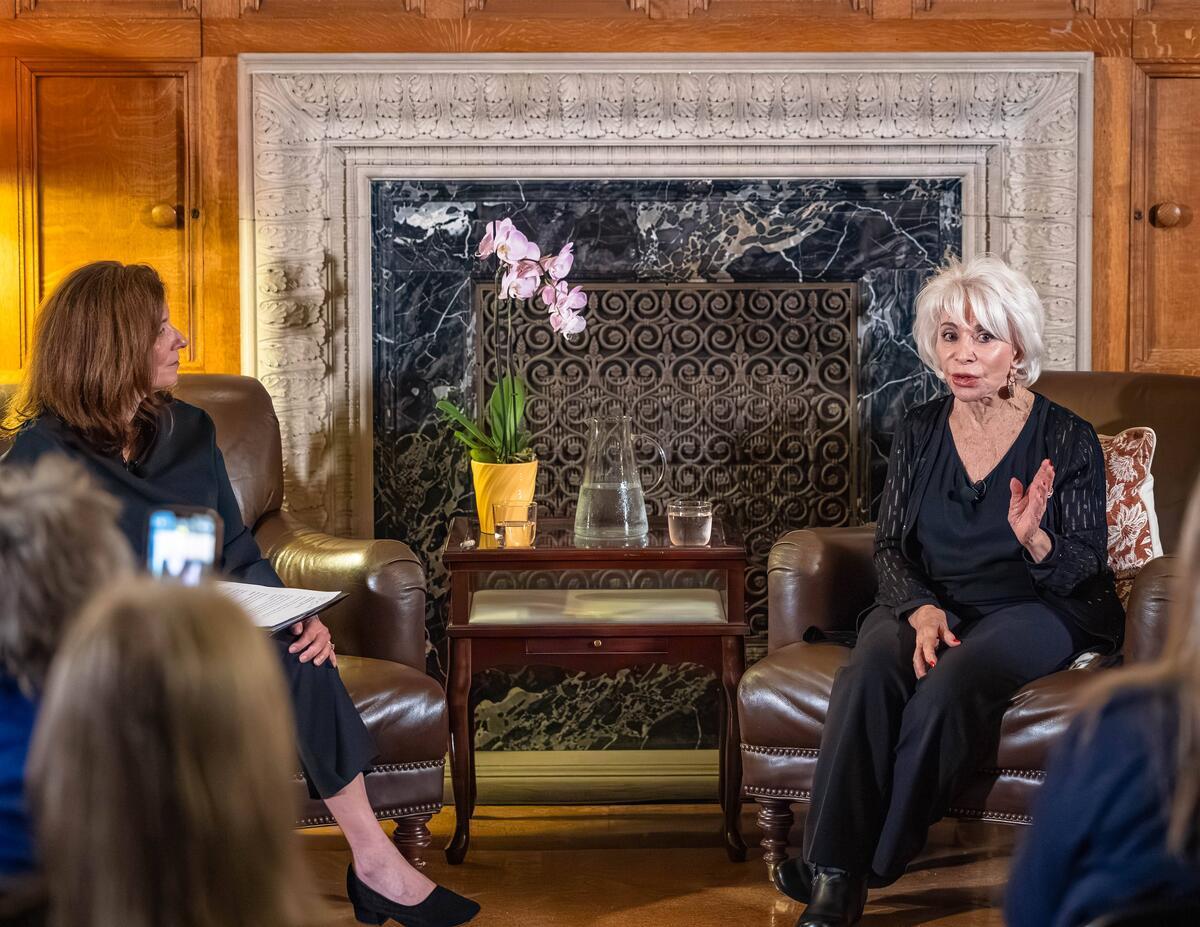
On November 5th, UC Berkeley’s Arts Research Center marked its 25th anniversary by welcoming internationally acclaimed novelist, feminist icon, and social activist Isabel Allende for an intimate conversation with Sara Guyer, the Irving and Jean Stone Dean of Arts and Humanities and Professor of English at UC Berkeley.
After a warm introduction from ARC Director Beth Piatote, who described the Center’s mission as “thinking through the arts,” Allende and Guyer took the stage to applause from a packed room and online audience. It was, as Piatote noted, the “one thing” she most wanted to do to celebrate ARC’s milestone year.
Asked how she decides what to write, Allende responded with her trademark mix of candor and humor: “I have written so many books because I don’t have a life. I can only write, and if I don’t write, I drive everybody nuts.” She described stories as “seeds” that lodge themselves in her body and begin to grow: “Sometimes one of those seeds starts to grow and starts bothering me. I dream about it. Then I know it’s time to give it a chance.”
Allende also shared the personal ritual that has shaped her career: she begins every new book on January 8. Whether or not she has a story the night before, she clears her calendar, organizes her materials, and sits down at the computer: “Sometimes I don’t have a story. But I know that if I show up every day in front of the computer, sooner or later, something is going to happen.” Research, for her, is a way to find “the unheard, the silenced voices” inside historical events. While official records may preserve battles and dates, she is drawn to “the women, the defeated, the young men who didn’t even know what they were fighting for… even the animals.” She relies on archives, letters, newspapers, and her retired-professor brother who, she joked, “has nothing to do but research.”
The evening turned serious when Guyer asked about Allende’s experience of dictatorship in Chile and the rise of authoritarianism. Allende spoke of the 1973 military coup that ended Chile’s long-standing democracy in a single day, of curfews, censorship, shuttered universities, banned unions, and the thousands who disappeared. She described participating in clandestine networks that hid people at risk, shuttling them between safe houses and embassies, and of the terror of hearing a car stop outside at night: “Life puts you in a situation in which sometimes you don’t have a choice.”
Reflecting on exile and migration, Allende distinguished her own path, coming to the United States as an established writer and legal immigrant, from the realities facing many refugees and undocumented people. But the advice she offers is the same:
“Bring it with you, your language, your food, your music, your traditions, your sense of family. You don’t have to sacrifice anything to get what America has to give you. Being bicultural is that you have everything.”
When asked about artificial intelligence and new technologies, Allende admitted both fascination and fear that one day “someone will be able to write any of my books much better in thirty seconds.” Yet she insisted that no technology can erase the human need for stories. Comparing handwritten letters from her mother, perfect calligraphy on beautiful paper, to their later email exchanges, she noted that while something was lost, something else was gained: immediacy, dialogue, everyday contact.
“The technology will change, but the need for the story will be there.”
Allende also spoke movingly about the death of her daughter, Paula, an experience she called incomparable to any other loss in her life. Her bestselling memoir Paula generated thousands of letters from readers sharing their own stories of grief. To honor her daughter, Allende created the Isabel Allende Foundation, which supports vulnerable women and girls in the areas of education, health, reproductive rights, and protection from violence. Though the scale of need can feel like “a desert,” she credits her daughter-in-law with reminding her to think “one person at a time.”
When asked what advice she would give to the many students and young writers in the audience, Allende hesitated to generalize, then offered this: “Take risks. There will be hurt and suffering. And so what? If you want to have a life, you have to have adventure. There’s nothing wrong with suffering.”
She added that she has “never learned anything from happiness, only from loss and pain,” and that writing has been the work that kept her alive inside: “Slowly but surely, I have become myself by creating each one of these characters.”
As the evening closed, the standing-room-only crowd rose again in applause. It was a fitting celebration of ARC’s 25 years of “thinking through the arts”: a night in which storytelling, politics, memory, and imagination were inseparable, and in which one of the world’s most beloved writers reminded Berkeley’s community that stories are both witness and invitation, a way to remember what has been lost and to insist on what might still be saved.
